Introduction
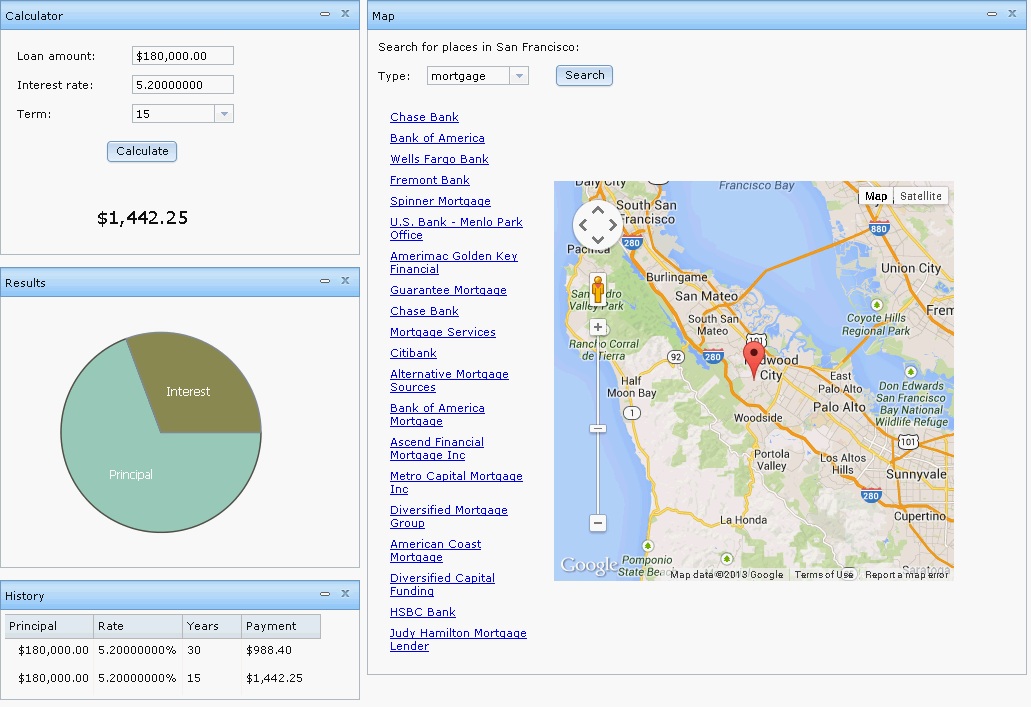
At run time, the user interacts with the Rich UI application. It was deployed to a server, was transmitted to the user's browser, and is running in that browser. From the browser, the Rich UI application accesses services, each of which runs remotely on a server and returns data to the application.
The use of different kinds of logic helps to provide a main benefit of Rich UI: Users can interact with a responsive, local-running web application even as the services do background work such as calculating mortgage payments.
In general, a web service is deployed as a SOAP service or REST service. For further details on the distinction between the two, see "Architectural styles in web services" at http:/publib.boulder.ibm.com/infocenter/rbdhelp/v8r0m0Architectural styles in web services.
- A remote SOAP service finds addresses of mortgage lenders and identifies the locations on a map.
- A second service is written by you and is deployed along with
the Rich UI application. This kind of service is called an EGL dedicated
service, and in this case it calculates the mortgage payments.
In general, you can use a dedicated service to do tasks that other EGL-generated Java™ services can do, such as accessing a database or file system. However, the dedicated service is not available to other code unless you redeploy it as an EGL-generated web service.
The benefit of a dedicated service results from its shared deployment with the Rich UI application. If a Rich UI application accesses a web service, your deployment of the application typically requires that you specify the service location. However, if a Rich UI application accesses a dedicated service, your deployment of the application does not require the location detail. Instead, the service will be available wherever you deploy the Rich UI application.
You can run the Rich UI application and access the service even before you deploy the application internally to a web project. That internal deployment creates the HTML file and embeds that file with others in a web archive (WAR) file, which is a compressed resource like a .zip file. After the Rich UI application and the dedicated service are deployed internally in this way, you deploy them to a server.
Learning objectives
The learning objectives are as described in Create a mortgage application with EGL Rich UI.
Time required
This tutorial takes about 2 hours to finish. If you explore other concepts related to this tutorial, it might take longer to complete.
- Line by line (most helpful): Complete the individual lessons to explore the code in small, manageable chunks, learning important keywords and concepts. This method also requires the greatest time commitment.
- Finished code files: At the end of each lesson in which you create a file, you can link to the completed code, which you can copy into the Rich UI editor.
Skill level
Introductory
Audience
This tutorial is designed for people who know the basic concepts of programming and want experience with EGL Rich UI.System requirements
To complete this tutorial, you must have the following tools and components installed on your computer:- Rational® Business Developer Version 8.0.1.2 or higher.
- A working Internet connection.
Prerequisites
You do not need any experience with EGL to complete this tutorial.