Tasks and data sets used for end-to-end scheduling with fault tolerance capabilities
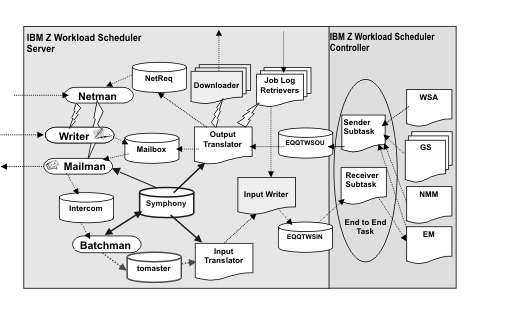
The server address space hosts the tasks and the data sets that function as the intermediaries between the controller and the IBM Workload Scheduler domain manager at the other end of the network. In many cases these tasks and data sets are a replica of the IBM Workload Scheduler tasks and data sets.
- Controller processes. They are:
- Sender
- Receiver
- End-to-end server. They are:
- Netman
- Writer
- Mailman
- Batchman
- Job log retriever
- Output translator
- Input translator
- Input writer
- Downloader
- Netman
- Replicates the IBM Workload Scheduler process. It starts at system startup. It monitors the NetReq.msg queue and the IBM Workload Scheduler TCP/IP port (usually 31111). When it receives a request, it starts the Writer or Mailman processes. The request to start or stop Mailman will come from the Output Translator via the NetReq.msg queue. The request to start or stop Writer will come from Mailman on the IBM Workload Scheduler domain manager via the TCP/IP port.
- Writer
- Replicates the IBM Workload Scheduler process. It is started by Netman on request from the Mailman of the connected IBM Workload Scheduler domain manager. Writer has the task of writing the events that it receives from the remote Mailman in Mailbox.msg.
- Mailman
- Replicates the IBM Workload Scheduler process.
Its main tasks are:
- Routing events. It reads the events stored in the Mailbox.msg queue and sends them either to the controller, writing them in Intercom.msg, or to the remote Writer on the IBM Workload Scheduler domain manager.
- Establishing the connection with the domain manager by calling the remote Netman to start Writer.
- Sending the Symphony™ to the other IBM Workload Scheduler nodes when a new Symphony™ is created.
If defined in the topology, Mailman can start other Mailman processes, called Mailman servers, to manage communication with specific workstations in the MASTERDM domain.
- Batchman
- Updates the Symphony™ file and resolves dependencies at master level. It replicates the functionality of IBM Workload Scheduler Batchman to a limited extent (submission has been removed).
- Job Log Retriever
- Receives from each distributed agent the log of a job run on the agent. After the Job Log Retriever has received the log, it sizes the log according to IBM Z Workload Scheduler specifications, translates it from UTF-8 to the EBCDIC codepage, and sends it to the Input Writer. The retrieval of a job log is a lengthy operation and users may request several logs at the same time. For this reason, a subtask is started for each job log retrieval. The subtasks are temporary and terminate after the logs are sent to the Input Writer.
- Output Translator
- Receives the events in IBM Z Workload Scheduler format
from the outbound queue and elaborates them to activate the correct IBM Workload Scheduler function.
It also translates event names from the EBCDIC codepage to UTF-8.
The Output Translator interacts with three different components depending on the type of the event:
- Starts a Job Log Retriever thread if the event is to retrieve the log of a job from an IBM Workload Scheduler distributed agent.
- Starts a Downloader thread if the event is to download the script.
- Enqueues an event in NetReq.msg if the event is to start or stop Mailman.
- Enqueues events in Mailbox.msg for the other events that are sent to update the Symphony™ file on the distributed agents (i.e. events for a job that has changed status, events for manual changes on jobs or workstations, or events to link/unlink workstations).
- Switches the Symphony™ files.
The Output Translator uses the IBM Workload Scheduler libraries to create the events and to enqueue them on the event files.
- Input Translator
- Translates the events read from the tomaster.msg to the IBM Z Workload Scheduler format, including UTF-8 to EBCDIC translation, and writes them in the inbound queue.
- Sender Task
- Is a subtask of the end-to-end scheduling with fault
tolerance capabilities task. It receives events from all the controller
tasks that make changes in the control program and enqueues the events
in the outbound queue. The events are received via SSI that is the
usual method the IBM Z Workload Scheduler tasks
use to exchange events. The tasks that change the control program
and that send events to the Sender Task are:
- General service (GS)
- Normal mode manager (NMM)
- Event manager (EM)
- Workstation analyzer (WSA)
The NMM sends events to the Sender Task during the daily planning for synchronization purposes.
- Receiver Task
- Is a subtask of the end-to-end scheduling with fault tolerance capabilities task. It receives events from the inbound queue and enqueues them to the Event Manager. The events have already been filtered and elaborated by the Input Translator.
- Input Writer
- Receives the input from Job Log Retriever and Input Translator and writes it in the inbound queue (EQQTWSIN).
- Downloader
- Sends scripts to remote agents. A thread is started for every script that must be downloaded and ends after the script has been downloaded.
IBM Z Workload Scheduler uses the following data sets for end-to-end scheduling with fault tolerance capabilities:
- Data sets on z/OS®:
- EQQTWSIN
- Sequential data set used to queue events sent by the server to the controller (inbound queue).
- EQQTWSOU
- Sequential data set used to queue events sent by the controller to the server (outbound queue).
- EQQSCLIB
- Partitioned data set used as a repository for the definitions of the jobs running on distributed agents. This data set is not shown in IBM Z Workload Scheduler data sets and files for end-to-end scheduling with fault tolerance capabilities.
- EQQSCPDS
- VSAM data set containing a copy of the current plan used by the daily plan batch programs to create the Symphony file. This data set is not shown in IBM Z Workload Scheduler data sets and files for end-to-end scheduling with fault tolerance capabilities.
- EQQTWSCS
- Sequential data set used to temporarily store a script when it is downloaded from the JOBLIB data set to the agent for its submission. This data set is not shown in IBM Z Workload Scheduler data sets and files for end-to-end scheduling with fault tolerance capabilities.
- Data sets on USS. The following filets are in the work directory
which is defined through the TOPOLOGY statement.
- Symphony™
- File containing the active copy of the plan used by the distributed agents. The daily planning batch job creates the Symnew file. The Translator renames Symphony in Symold and Symnew in Symphony. The Translator creates also the Sinfonia file that contains the copy of the Symphony file used by the distributed agents.
- Sinfonia
- File containing the distribution copy of the plan used by the distributed agents.
- NetReq
- File used to queue requests for the Netman process.
- Mailbox
- File used to queue events sent to the Mailman process.
- Intercom
- File used to queue events sent to the Batchman process.
- Tomaster
- File used to queue events sent to the Translator process.