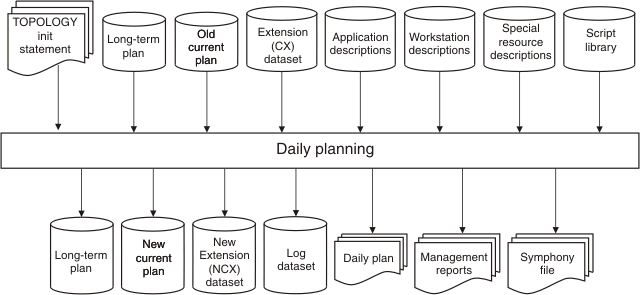
Daily planning uses data from several IBM® Z Workload Scheduler data
sets:
The long-term plan (LTP), which contains a list of application
occurrences to run each day. The long-term plan details the input
arrival and deadline times as well as external dependencies for every
occurrence.
The existing current plan. Uncompleted applications need to be
included in the new plan, and completed applications are reported
on.
The
application description database, which contains the detail of applications
at operation level.
The workstation
description database, which shows the open intervals, parallel servers,
and fixed resources available at each workstation.
The resource description
database, which has details of special resources.
The data is collected and used to update the relevant data sets
and produce the current plan reports. The daily planning process involves:
Update of the long-term plan for occurrences that are marked complete
or have been deleted in the existing current plan
Creation of an updated current plan, called the new current
plan (NCP), that contains:
Uncompleted operations from the existing current plan.
Potential predecessor records for each occurrence. The records
are used to establish a list of candidates for successor resolution
when an occurrence is added to the current plan using the panel, the
program interface, or event-triggered tracking.
The daily planning process writes messages to the EQQMLOG and SYSPRINT
data sets. Error and warning messages are indicated by a nonzero return
code from the batch job. These messages should be investigated immediately;
they can indicate a potential problem in the new plan.
In some cases, where the error is severe, the daily planning process does not create a new
current plan. For example, if the daily planning process detects a loop in a chain of
dependent operations, a new current plan is not created. For a description about how daily
planning analyzes dependency loops, see Analyzing problems reported by daily planning.