Introducing APPC
Personal Communications and Communications Server provide Advanced Peer-to-Peer Networking® (APPN®) end-node support for workstations, enabling them to communicate more flexibly with other systems in the network.
Personal Communications and Communications Server provide advanced program-to-program communications (APPC) to support communications between distributed processing programs, called transaction programs (TPs). APPN® extends this capability to a networking environment. The transaction programs can be located at any node in the network that provides APPC.
Personal Communications and Communications Server improve APPC throughput in local area network (LAN) environments and supports APPC over various protocols such as: IBM Token-Ring Network, Synchronous Data Link Control (SDLC), and Ethernet.
- Communications Server running on Windows®
- SNA API clients for Windows® that are delivered with Communications Server
- Personal Communications for Windows
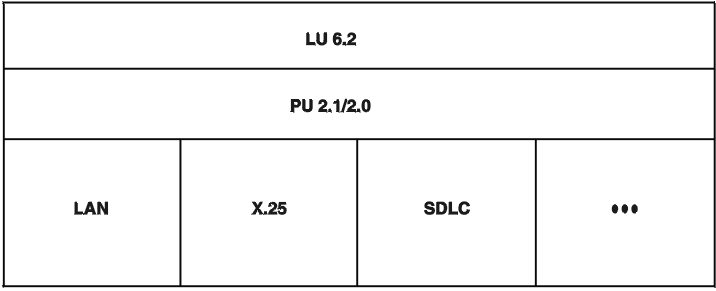
Personal Communications or Communications Server APPC Implementation illustrates the functional structure of an implementation of APPC for either Personal Communications or Communications Server.