case
The EGL case statement provides an alternative to multiple nested if statements. Based on one or more evaluations, EGL selects one set of statements to run from various alternatives. The case statement is similar to a C switch or a COBOL EVALUATE statement.
The statement has two main forms. In the first version, EGL evaluates a single criterion and looks for a matching value among the when clauses. In the second version, you do not supply a top-level criterion and EGL evaluates a logical expression for each when statement in turn, running the code for the first expression that evaluates as true. In the first version, the only condition EGL evaluates is simple equality to the criterion. The second condition offers greater flexibility and comparisons based on inequalities, ranges of values, and so on.
- Any expression that can be on the left of an "equals" comparison operator (==). Here the match expression can be anything that can be on the right of the "criterion ==" comparison.
- converseVar.eventKey. The match expression is the name of a key (anything that can be on the right of the "converseVar.eventKey IS" comparison).
- SysVar.systemType. The match expression is the name of a system type, in quotation marks (anything that can be on the right of the "SysVar.systemType IS" comparison).
No other criteria are valid. For example, you cannot compare one record to another, or compare an I/O object (like a SerialRecord) to endOfFile.
As in COBOL, but not as in C, control does not fall through from one when clause to the next. After the statements run in a when or otherwise clause, control passes to the EGL statement that immediately follows the end of the case statement. If EGL does not match a when clause or find an otherwise clause, control also passes to the next statement following the end of the case statement, without causing an error.
If a single clause includes multiple match expressions (see "Example" in this topic), EGL evaluates those expressions from left to right, and stops when it finds a match.
Syntax
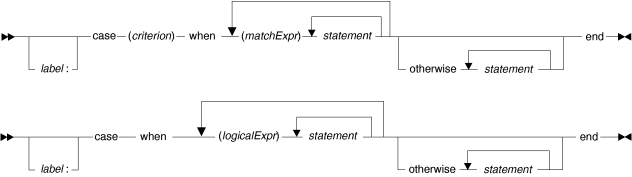
- label
- A label, followed by a colon, which an exit statement can reference. For more information, see Conditional and loop statements.
- criterion
- A variable, constant, expression, literal, or system variable
(such as converseVar.eventKey or sysVar.systemType).
If you specify criterion (first syntax diagram), each of the subsequent when clauses must contain one or more instances of matchExpression. If you do not specify a criterion (second syntax diagram), each of the subsequent when clauses must contain a logical expression.
- when
- The beginning of a clause that is invoked only in one of the following
cases:
- You specified a criterion, and the when clause is the first to contain a matchExpression that is equal to the criterion.
- You did not specify a criterion, and the when clause is the first to contain a logical expression that evaluates to TRUE.
If you code the clause without EGL statements, control passes from the case loop without invoking the otherwise clause.
A case statement may have any number of when clauses.
- matchExpression
- An expression to which the criterion is compared. For more information, see "Match expressions" in this topic.
- logicalExpression
- An expression that resolves to either TRUE or FALSE. For more information, see "Logical expressions."
- statement
- A statement to be run if EGL matches the associated when expression or reaches the associated otherwise clause.
- otherwise
- The beginning of a clause that EGL invokes if unable to match a when expression.
Example
  case (myRecord.requestID)
    when (1)
      myFirstFunction();
    when (2, 3, 4)
      try
        call myProgram;
      onException(iex InvocationException)
        myCallFunction(fileEx);
      end
    otherwise
      myDefaultFunction();
end Program calc3
x INT = 3;
y INT = 5;
z INT = 7;
function main()
case
when (x == 3)
writeStdOut("x passes");
when (y == 5)
writeStdOut("y passes");
when (z == 7)
writeStdOut("z passes");
otherwise
writeStdErr("You should not see this msg");
end
endThe console shows the words "x passes". The case statement ends when a TRUE expression is found.